
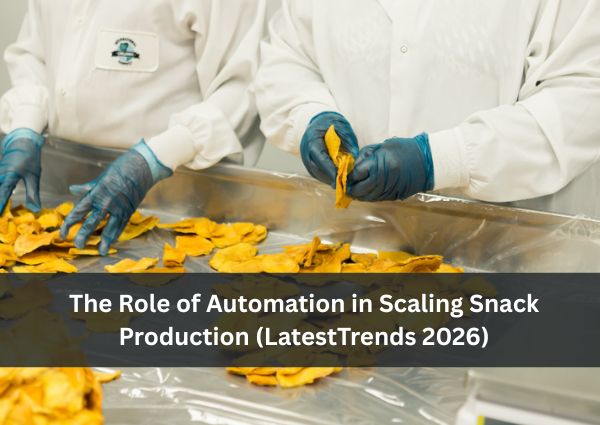
The Indian snack industry is entering a new phase of growth in 2026. Consumers are demanding more variety, faster product launches, consistent quality, and convenient packaging, while snack brands are expanding from regional markets to national and international distribution. To meet these demands efficiently, manufacturers are increasingly adopting automation, robotics, connected machinery, and AI-powered quality systems.
Automation is no longer limited to large factories. Modern snack production lines can integrate automated mixing, extrusion, frying, seasoning, weighing, packaging, inspection, and material handling into a coordinated production system. India’s emerging food-manufacturing ecosystem is also increasingly focusing on smart-factory technologies, including AI, IoT, robotics, MES, and automated packaging.
At Anantjeet Nutriments, we recognize automation as an important part of building efficient and scalable snack manufacturing capabilities. From potato chips and namkeen to extruded snacks and other ready-to-eat products, automation can help manufacturers achieve greater consistency while responding to increasing market demand.
Why Automation Is Important in Snack Manufacturing
Traditional snack production can involve significant manual intervention. While skilled workers remain essential, manual processes can create variations in weight, seasoning, cooking, packaging, and product handling.
Automation helps manufacturers achieve:
- Consistent production
- Higher output
- Better process control
- Reduced product variation
- Improved packaging accuracy
- Lower material wastage
- Better production monitoring
For brands experiencing rapid growth, these advantages can make scaling much easier.
Automated Processing From Raw Material to Finished Snack
Modern snack manufacturing can automate several stages of production. Depending on the product, automated systems can coordinate raw material preparation, mixing, extrusion, frying or baking, seasoning, cooling, conveying, and packaging.
This integrated approach reduces unnecessary handling between production stages and allows manufacturers to maintain more consistent operating conditions.
For example, extrusion-based snacks require careful control of ingredients, moisture, temperature, pressure, and expansion. Automated equipment can maintain these parameters more consistently than manual adjustments.
Automation in Potato Chips Production
Potato chips require precision at several stages, including slicing, washing, frying, seasoning, and packaging.
Automated systems can help maintain:
- Consistent slice thickness
- Controlled frying conditions
- Uniform seasoning
- Accurate product weighing
- Efficient packaging
This becomes particularly important when production volumes increase. A manufacturer supplying multiple markets cannot depend entirely on manual processes to maintain identical results across every batch.
Smart Extrusion and Snack Production
Extrusion technology is particularly suited to automation because several processing parameters must be controlled simultaneously.
Modern systems can monitor variables such as:
- Temperature
- Pressure
- Moisture
- Feed rate
- Production speed
Consistent control of these factors helps manufacturers produce snacks with uniform shape, density, expansion, and texture.
For a growing snack brand, this consistency is essential because consumers expect the same product experience every time they purchase it.
Robotics in Packaging and Material Handling
Packaging is another area where automation is rapidly transforming snack production. Automated weighing, filling, sealing, coding, case packing, and palletizing systems can significantly improve production efficiency.
Robotic systems can also handle repetitive material movement and end-of-line operations. Industry projections for 2026 point toward increasing use of robotics in food packaging and palletizing as manufacturers pursue greater efficiency and consistency.
Automation can reduce repetitive manual handling while allowing employees to focus on quality control, maintenance, supervision, and other higher-value activities.
AI-Powered Quality Control
One of the most significant developments in 2026 is the increasing integration of artificial intelligence with manufacturing data.
AI systems can analyze large volumes of production information and identify patterns that may be difficult to detect manually. This can support early identification of quality variations and process abnormalities.
A particularly notable 2026 example comes from potato snack manufacturing: Kellanova has developed an AI-powered digital twin for Pringles production that analyzes more than 200 variables, including raw-material characteristics, to recommend process adjustments. The system has reportedly improved quality by 10% and reduced waste by 13% on its production line.
This demonstrates how automation is moving beyond simply making machines faster. The next generation of manufacturing is about making production systems more intelligent.
Digital Twins and Predictive Manufacturing
Digital twin technology is becoming increasingly relevant to modern food production. A digital twin creates a digital representation of a physical manufacturing process and uses real-time information to understand how the production system is performing.
For snack manufacturers, this technology can potentially help with:
- Process optimization
- Predictive maintenance
- Quality monitoring
- Waste reduction
- Production planning
Instead of reacting after a problem occurs, manufacturers can increasingly identify potential issues earlier and make informed adjustments.
Automated Packaging for Better Shelf Life
Automation also plays an important role after snacks leave the processing stage. Accurate filling and sealing help protect products from moisture, air, and external contamination.
Automated packaging systems can improve:
- Weight accuracy
- Seal consistency
- Production speed
- Pack quality
- Batch coding
- Traceability
This is especially important for chips, namkeen, and extruded snacks because maintaining crispness and freshness is essential to consumer satisfaction.
Reducing Waste Through Automation
Material waste is an important concern for snack manufacturers. Excess seasoning, inaccurate filling, product breakage, inefficient frying, and packaging errors can all increase production losses.
Automation can help identify variations and improve process precision.
Better control over ingredients and processing conditions can contribute to:
- Higher production yield
- Reduced raw-material losses
- Lower packaging waste
- Better energy utilization
As sustainability becomes increasingly important, waste reduction is becoming both an environmental and commercial priority.
Automation Does Not Replace Human Expertise
Despite rapid technological development, automation does not eliminate the importance of skilled employees.
Human expertise remains essential for:
- Product development
- Recipe innovation
- Quality decisions
- Equipment supervision
- Maintenance
- Consumer-focused innovation
The most effective factories combine automation with human decision-making rather than treating them as alternatives.
What Automation Means for Snack Brands
For snack brands, automated manufacturing can provide several strategic advantages. Higher production capacity allows brands to respond to growing orders without sacrificing consistency.
It can also support:
- Faster product launches
- Multiple flavor variants
- National distribution
- Private label production
- Seasonal demand
- Export expansion
For emerging brands, access to an experienced manufacturer with modern production capabilities can eliminate the need to invest immediately in their own large-scale factory.
The Future of Snack Manufacturing in India
The next stage of snack manufacturing will likely involve increasingly connected production environments. Automation, IoT, AI, robotics, digital twins, smart packaging, and real-time analytics are expected to work together rather than operate as isolated technologies.
India’s food-processing technology ecosystem is already highlighting smart-factory solutions covering automation, robotics, AI, IoT, manufacturing software, energy systems, and packaging technology.
For manufacturers, the goal will be to create production systems that are faster, more flexible, more resource-efficient, and capable of maintaining consistent quality at increasing volumes.
Conclusion
Automation is becoming a major driver of snack manufacturing growth in 2026. From automated extrusion and frying to robotic packaging, AI-powered quality monitoring, and digital twins, modern technology is helping manufacturers produce larger volumes while maintaining consistency and reducing waste.
At Anantjeet Nutriments, we believe that combining manufacturing expertise with modern technology is essential for meeting the evolving needs of snack brands. Automation can help businesses scale efficiently while maintaining the taste, texture, quality, and reliability that consumers expect.
As India’s packaged snack industry continues to expand, manufacturers that embrace smart automation while retaining strong human expertise will be better positioned to support the next generation of innovative snack brands.